
I’ve heard this complaint too many times: “Hammock? Oh, I tried it once, and my back hurt like crazy. The middle sagged, and I bent like a banana.”
If you’ve had similar experiences and have relegated outdoor hammocks to the “uncomfortable” category, I ask you to set that prejudice aside. The truth may be quite the opposite: a well-designed, properly used hammock can provide near-perfect spinal support, with comfort possibly surpassing even the most expensive sofa in your living room.
The problem isn’t the hammock itself, but our ingrained notions of “beds” and “chairs,” which lead us to misuse this amazing suspension-based device. Today, let’s set aside intuition and explore the core of hammock ergonomics, where science and geometry join forces to support your perfect afternoon nap.
Puzzle 1: The Parabola—How Gravity Becomes Your Invisible Masseuse

To understand hanging bed comfort, first understand its shape. A rope or fabric fixed at both ends, sagging freely in the middle, naturally forms a beautiful curve—mathematically called a catenary, approximating a parabola.
This isn’t just aesthetics; it’s the physics of comfort. When you lie in a properly hung hammock, your body weight distributes along this curve. Unlike a hard flat bed or the ground, the flexible curve dynamically conforms to your body’s natural arc, especially the lumbar curve of your spine.
Imagine: your hips are your heaviest part, naturally settling at the curve’s lowest point. Your head and feet are gently elevated. The hammock fabric acts like a soft hand, lifting your lumbar region and spreading pressure over a larger surface rather than concentrating it on a few hard points (like hips or shoulder blades). This even support is key to relieving pressure and promoting relaxation.
In contrast, a mattress that’s too soft lets your spine sag into an unnatural “C,” while a board that’s too hard presses at key points. The hammock’s parabola strikes the golden balance between the two extremes.
Puzzle 2: The 30-Degree Rule—The Magic Switch from “Banana” to “Flat.”
Now we hit the culprit behind the “banana” discomfort: suspension tension.
Most beginners make the mistake of stretching the hammock like a clothesline, thinking “tighter is better.” In hammock world, tautness is the enemy of comfort.
If the hammock is too tight, the deep, embracing parabola is forcibly flattened into a shallow arc or nearly a straight line. The result: high edges, a low middle, and your body is forced to curl into a narrow trough, overbending the spine—causing all discomfort.
The magic of the “30-degree rule”
This rule is the key to solving the problem. It states: when the hammock is hung but empty, the straps or ropes from anchor points (trees, posts) should form an angle of about 30 degrees with the horizontal.
Why 30 degrees? Practice shows it gives enough sag to create the flattest, most spacious central lying area. The parabola’s “bowl” becomes wide and gentle. No protractor needed; visually, a properly hung empty hammock should sag like a gentle smile, not a tense “grimace” or collapsed “frown.”
This simple adjustment marks the difference between suffering and enjoying. It requires no special gear, just resisting the instinct to “tighten it.”
Puzzle 3: Fabric and Size—The Foundation of a Dynamic Support System

The role of fabric: flexible support
Hammock fabric (usually nylon) is not a passive sheet. It must have stretch and strength. Slight elasticity lets the material conform to your body, creating a custom wrap; high strength ensures safety and reliability. Quality breathable nylon balances flexibility and durability, translating the theoretical comfort of the parabola into real tactile support.
The key of size: finding the “flat diagonal” canvas
Width directly affects your ability to achieve the perfect lying position. A narrow hammock wraps you from the sides, restricting stretch. A wide hammock provides the space to exploit the diagonal.
This is the core of why experienced users lie diagonally: lying at an angle (typically 20–45 degrees) relative to the long axis of the hammock uses the width. Your body tension spreads the fabric sideways, turning the longitudinal parabola into a nearly flat diamond-shaped support. The back, hips, and legs receive even support, and the spine stays naturally straight.
This is why many recommend double hammocks even for solo use. The extra width isn’t to fit two people but to allow luxurious solo stretches. Combined with a 300 kg weight capacity, it ensures safety and freedom while exploring the optimal diagonal. Color options like deep green or vibrant blue are aesthetic bonuses atop ergonomic design.
Hammock Ergonomics Quick Q&A
| Question | Answer |
|---|---|
| Even lying diagonally and hanging loose, why do I sometimes feel a gap under my lower back? | This is common. Even on the diagonal, the lumbar curve can leave a small void. Solutions: use a small inflatable pillow or rolled jacket under your knees (to adjust pelvic angle) or under your lower back. Also ensure your diagonal angle is sufficient—rotate more until back pressure disappears and you feel fully supported. |
| Are there “ergonomic hammocks” for people with back issues? | Rather than seek a special label, understand the principles: sufficient width (for diagonal flattening), supportive fabric (not saggy), and proper hanging method. A wide, high-capacity hammock with correct tension offers uniform, zero-pressure support, often friendlier than a hard mattress. For serious back issues, consult a doctor. Many discomforts stem from overly tight or narrow hammocks. |
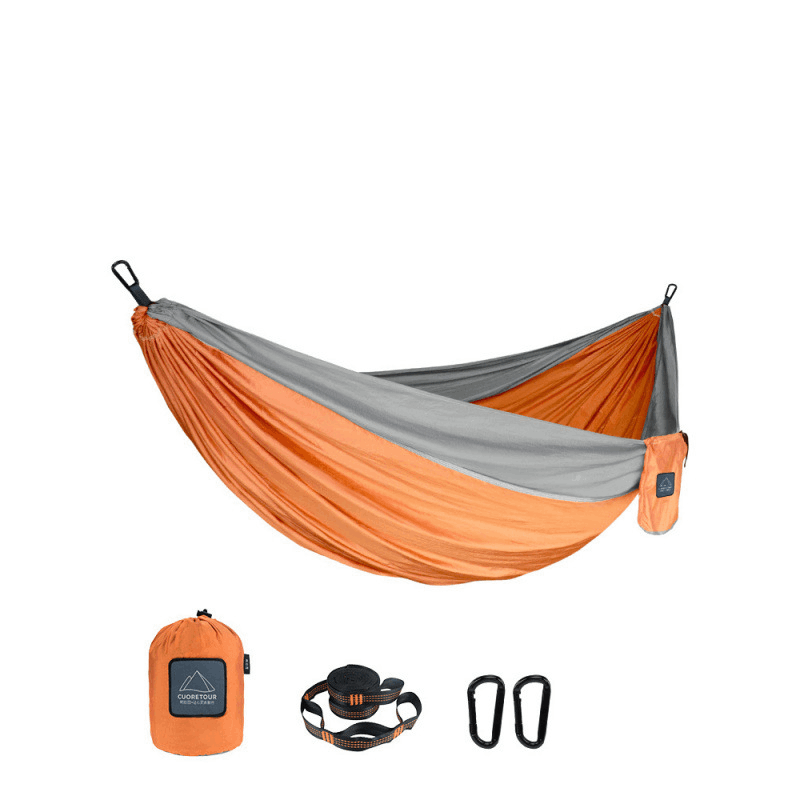
So, hammock comfort isn’t luck—it’s a precise collaboration: gravity shapes the parabola, geometry determines the optimal hanging angle, and adequate size plus proper fabric provide the stage.
It requires abandoning rigid “flat hard” support ideas and embracing dynamic, enveloping, flexible support. Hang loose, lie diagonally, and choose wide—and you unlock a unique relaxation experience.
This is not just physical ease but a mental shift. You are no longer “lying on something” but embraced by a system designed according to natural laws. Invest in a wide, reliable outdoor hammock, trust the science, adjust your posture, and sink into the exquisite comfort woven by gravity and fabric. Beneath that swaying sky lies the deepest promise of outdoor leisure.
Learn ergonomic hammock techniques with wide, durable designs that support diagonal lying for optimal outdoor relaxation