
You’re lying there, suspended in mid-air, completely relaxed. It feels effortless, almost magical. But the reality is, your peaceful rest is a tiny masterpiece of practical engineering. That simple-looking piece of fabric is the result of centuries of refinement in materials, structural physics, and human-centered design. Understanding the ingenious technologies behind the hammock that make it safe, comfortable, and durable doesn’t diminish its magic. It makes you a smarter buyer and a more confident lounger, ensuring your next choice is as sound as the bridge it’s metaphorically based on.
Let’s pull back the curtain on the humble hammock. We’re going beyond marketing terms to explore the material science, the physics of the hang, and the ergonomic principles that transform a nylon sheet into your favorite outdoor throne.
Material Matters: It’s Not Just “Fabric”

At its core, a hammock is a suspended load-bearing structure. The material is its foundation, and not all fabrics are created equal. Modern hammocks have moved far beyond traditional rope or cotton.
The gold standard today is high-grade nylon, and for good reason. Nylon offers an exceptional strength-to-weight ratio, excellent tear resistance, and inherent elasticity that provides a forgiving, comfortable lay. But within nylon, there are crucial distinctions that directly impact performance.
- Durability & Feel: Take our Classic Hammock or the Nylon Tent-like Outdoor Hammock. They use a soft, breathable nylon that prioritizes comfort for long-term lounging. This fabric is durable enough for backyard and camping use, resisting UV rays and moisture to maintain its integrity season after season. It’s the everyday workhorse fabric.
- Performance for Adventure: Now, look at the Ultra-Light Travel Hammock. It’s engineered for a different mission. Its “quick-dry nylon material” is a tighter weave, often with a lower denier, making it exceptionally lightweight and packable. The “triple stitching technology” isn’t just a buzzword; it redistributes stress along the seams, preventing a single weak stitch line from becoming a failure point during ultralight backpacking with a full load. This is material science tailored for minimalism and resilience on the trail.
- Specialized Protection: The Outdoor Mosquito-proof Hammock introduces another layer: a fine mesh of nylon no-see-um netting. This “aviation-grade tear-resistant nylon fabric” for the main body is chosen not just for its 250 kg load rating but for its ability to resist punctures from branches and abrasion from straps, while the netting provides a vital, delicate barrier. Each material serves a precise function in the system.
The Physics of the “Sag”: Finding the Sweet Spot
This is where most first-time users go wrong, leading to an uncomfortable, banana-shaped lie. The key to hammock comfort is understanding the structural curve.
A hammock is essentially a catenary curve—the same shape a free-hanging chain makes under its own weight. When you lie in it, you become the load. The optimal hang has a significant sag, typically around a 30-degree angle between the hammock attachment point and the tree or stand.
Why does this angle matter?
- Flatter Lie: A deep sag allows the fabric to spread out widthwise, creating a flatter, more bed-like surface that doesn’t curl around you.
- Proper Force Vectors: At this angle, the tension forces are directed more along the length of the hammock and its straps, rather than creating extreme downward pressure. This is critical for both comfort and safety. It’s why the 300 kg rating on our heavy-duty models is a safe working load, not a point of failure, when hung correctly.
- Stability: A well-angled hang is more stable and less prone to dramatic tipping.
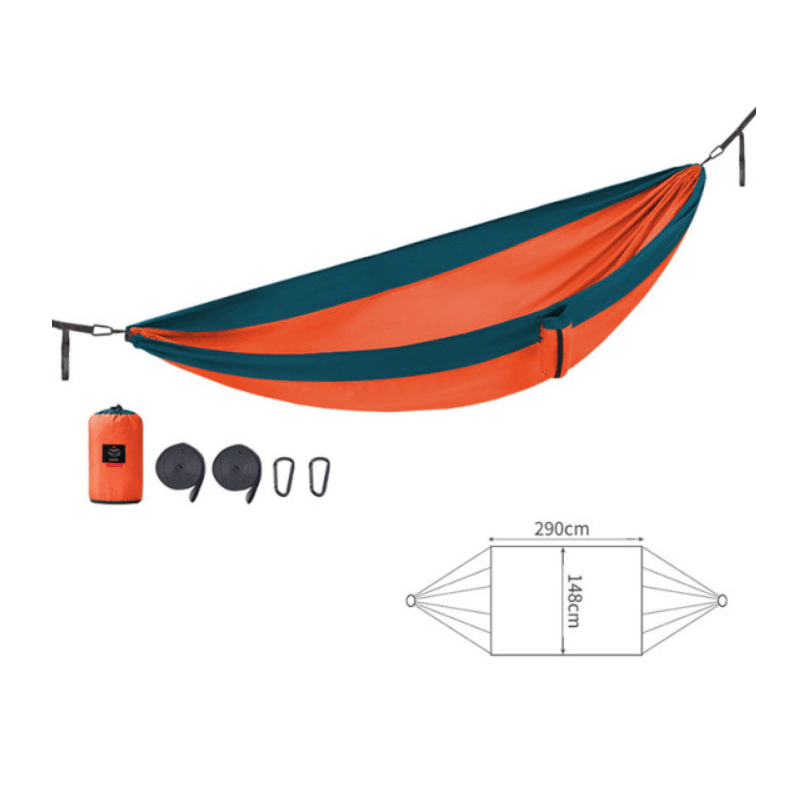
The included straps on models like the Outdoor Mosquito-proof Hammock (with its anti-slip design) or the Ultra-Light Travel Hammock are engineered for this. They are not just ropes; they are adjustable suspension systems that let you easily dial in this perfect angle without complex knots, making proper setup foolproof in under three minutes.
The Suspension System: Your Critical Link

This is the unsung hero, the component that literally connects you to the anchor points. A hammock is only as strong as its weakest link, and the suspension is often it.
Modern systems have evolved from simple ropes to sophisticated, tree-friendly webbing. Wide nylon straps (at least 1 inch wide) distribute pressure over a larger area on the tree bark, preventing damage and meeting “Leave No Trace” principles. The buckles or cinch mechanisms, like the aluminum hooks on the Ultra-Light model, are designed for high strength and easy adjustability.
When you see a load-bearing rating like 180 kg, 250 kg, or 300 kg, that rating must encompass the entire system: the fabric, the end-channel stitching, the carabiners, and the straps. A quality hammock like those in our lineup is engineered as a complete, integrated system where all components are matched to safely handle the stated load.
Ergonomics of a Floating Body
A good hammock doesn’t just hold you; it supports you. This is where design intersects with anatomy.
Unlike a flat bed or a rigid chair, a properly hung hammock cradles your body along its length. Your spine is allowed to settle into a gentle, natural curve. Pressure points on your heels, hips, and shoulders are minimized because your weight is distributed across a larger, conforming surface area. This can lead to deeper muscular relaxation than static surfaces.
The option for a double size in most of our models isn’t just about fitting two people; it’s about providing extra fabric width for a single user. This allows the walls of the hammock to come up around you slightly, creating a cozy, wrapped feeling that enhances the sense of security and privacy, whether you’re in a camping site or on your balcony.
Choosing with Knowledge: The Tech Behind the Type
Armed with this know-how, your buying decision shifts from “which color?” to “which engineered solution?”
- For Maximum Comfort & Social Lounging: You want the material and structural integrity for daily, relaxed use. The Nylon Tent-like Outdoor Hammock and the Classic Hammock, with their robust 300 kg-rated systems and comfortable fabric, are designed as reliable, long-term comfort platforms. Their wide straps protect your trees and ensure an easy, perfect hang every time.
- For Performance & Ultralight Travel: Your priority is advanced materials and minimal weight. The Ultra-Light Travel Hammock is your tool. Featuring triple-stitched quick-drying nylon fabric, high-strength micro-ropes, and aluminum alloy fittings, it’s designed to minimize weight while maintaining a safe 180 kg load-bearing capacity. It’s engineering for efficiency.
- For integrated environmental protection, you need a specialized system. The Outdoor Mosquito-proof Hammock combines durable body fabric with a delicate but essential mesh, all supported by a reliable suspension. It’s a two-material solution to a specific problem, demonstrating how hammock design adapts to user needs.
Rest Assured, on Solid Science
Your hammock is a quiet testament to human ingenuity. From the molecular bonds in its nylon fibers to the elegant catenary curve it forms under your weight, every element is there for a reason. This hidden engineering is what transforms a concept into a cocoon of trustworthy comfort.
So the next time you climb in, take a moment to appreciate not just the view but the invisible calculations holding you up. You’re not just lying in a hammock; you’re experiencing a perfectly balanced piece of practical design. Experience intelligently engineered comfort. Discover the technology inside our premium hammocks now.
Choose with confidence. Explore our collection of intelligently engineered hammocks, where every stitch, strap, and seam is designed for comfort, safety, and peace of mind.