

You’re lying in your hammock, swaying gently, a book resting on your chest as dappled sunlight filters through the leaves. It feels like a personal, modern invention—your little slice of suspended paradise. But the story of that simple piece of fabric and rope beneath you is a globe-trotting epic, weaving through ancient empires, naval history, and countercultural revolutions before landing in your garden. The hammock isn’t just a product for sale; it’s a cultural artifact with a past far richer than most of the gear in your garage.
Today, we hang them for leisure, but for centuries, the hammock was a tool of survival, innovation, and social status. Understanding this journey doesn’t just add trivia; it deepens our appreciation for that perfect afternoon sway and reveals why this ancient design remains utterly irreplaceable in our modern world.
The Original “Bed” of the Americas: Survival, Not Relaxation
Long before it was a symbol of outdoor leisure, the hammock was a practical masterpiece of indigenous ingenuity. Its origins are most commonly traced to the Maya and Taino peoples of Central and South America over a thousand years ago. For them, it wasn’t about “ultimate relaxation”; it was about smart living.
Suspending a sleeping surface off the ground provided crucial protection from moisture, insects, snakes, and other ground-dwelling pests. In tropical climates, it allowed air to circulate beneath the sleeper, offering cooling relief. It was also space-efficient and portable—key for communities that might need to move. When Christopher Columbus encountered the Taino in the Bahamas in 1492, he noted their “beds of cotton netting.” He brought the concept back to Europe, where it would soon find a deadly serious new home: the wooden decks of sailing ships.
Conquest, Commerce, and the Age of Sail

The European adoption of the hammock is a stark lesson in functional appropriation. Sailors on long voyages faced miserable conditions, often sleeping on wet, hard, and vermin-infested decks. The hammock solved multiple problems at once. It kept sailors dry, maximized cramped sleeping quarters (as they could be hung in tiers), and its gentle rocking countered the ship’s roll, allowing for better rest.
By the 16th century, the naval hammock was standardized. It became so synonymous with seafaring that even today, the term “hit the sack” is believed by some etymologists to refer to sailors climbing into their hammocks, or “sacks.” This period transformed the hammock from a regional indigenous technology into a global tool of exploration, conquest, and trade. It was no longer just a bed; it was essential gear for building the modern world.
The Counter-Culture Swing and the Birth of Leisure
The hammock’s journey from military necessity to leisure icon began in earnest in the 19th and early 20th centuries, as colonialism and travel writing romanticized “exotic” tropical life. But its true mainstream breakthrough as a symbol of relaxation came with the mid-20th century boom in camping, backyard living, and the embrace of outdoor leisure by the middle class.
The post-war era ideal of the suburban backyard provided the perfect canvas. No longer needing tree trunks, families could buy a hammock with a stand, plop it on the lawn, and instantly evoke a sense of vacation. It became a staple of family photos, lazy Sunday afternoons, and a symbol of earned relaxation. Then, in the 1960s and 70s, the hammock was adopted by the backpacking and counterculture movements. Its portable, minimalist, and low-cost nature resonated with a desire to get back to basics and escape rigid societal structures. To “hang out” in a hammock was, subtly, a small act of dropping out.
Modern Tribes and Their Suspended Sanctuaries
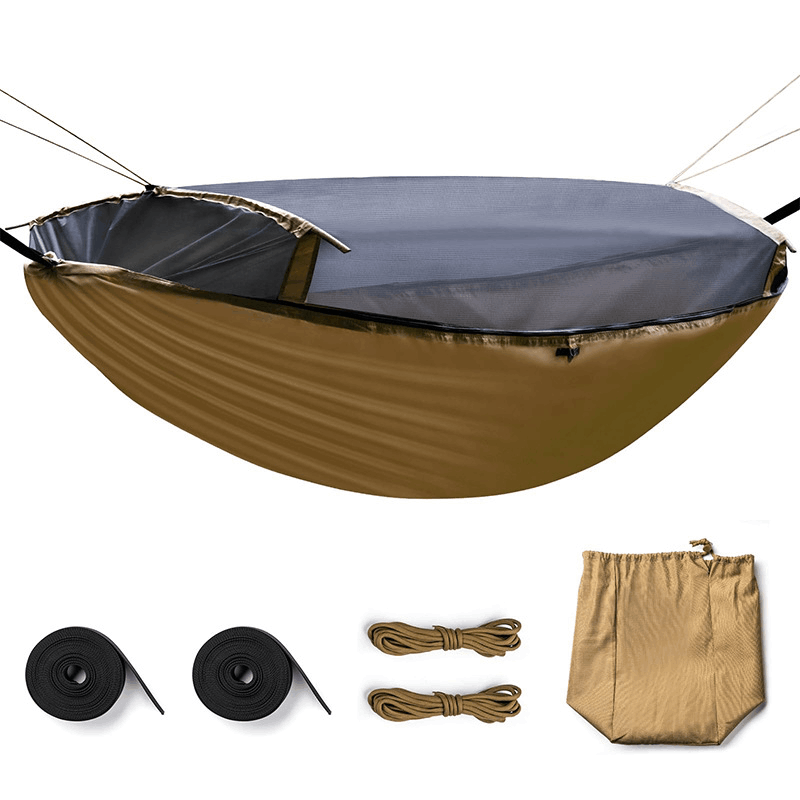
Today, the hammock has splintered into subcultures, each with its own preferred gear and ethos. Your choice of hanging bed quietly signals which tribe you belong to.
- The Ultralight Purists: This tribe lives by the mantra “ounces equal pounds, and pounds equal pain.” For them, the Ultra-Light Travel Hammock is a sacred object. Its existence, packing smaller than a water bottle, is a triumph of modern material science. They debate the merits of straps vs. whoopie slings, seek the perfect “hang angle,” and see the world as a series of potential anchor points between two tree trunks. Their hammock isn’t just a bed; it’s the centerpiece of a sophisticated ultralight backpacking sleep system, paired with underquilts and tarps. For this guy or gal, the hammock represents freedom from the ground, weight, and conventional campsites.
- The Backyard Enthusiasts & Family Campers: This is the largest and most casual tribe. Their hammock is about accessibility and shared comfort. They gravitate towards the robust, colorful, and user-friendly options like the Nylon Tent-like Outdoor or the timeless Classic Hammock. The double size is popular, not just for couples but also for becoming a cozy nest for kids and pets. For them, the hammock is a social space on the patio, a reading nook, or a comfortable alternative to a camp chair. They might own a dedicated hammock stand for indoor or deck use, fully integrating the swing into their daily domestic life. A trip to the beach or a drive-up camping site isn’t complete without it.
- The Bug-Bitten Adventurers: Operating in the Venn diagram overlap of the first two tribes is a group defined by their war on mosquitoes. Their hero product is the Outdoor Mosquito-proof Hammock. This isn’t a mere accessory; it’s a fortress. With it, they can enjoy the lush forests, lakesides, and damp nights without worrying about mosquito bites—perfect spots for a hammock. For this tribe, the integrated netting isn’t a feature; it’s the main event, transforming a vulnerable rest into a peaceful, protected cocoon.
More Than a Product: A Symbol in Fabric
The hammock endures because its core promise transcends its utilitarian history. It is a physical metaphor for balance, surrender, and perspective. To lie in a hammock is to literally and figuratively suspend yourself between two points—between work and rest, effort and ease, earth and sky.
It forces a change in posture and outlook. You look up at the canopy or the clouds, not down at your phone. The gentle motion encourages a mental unwinding that a static chair or bed cannot. In our hyper-connected, productivity-obsessed culture, the act of getting into a hammock is a quiet declaration that, for now, you are opting out. You are participating in a ritual of rest that spans continents and centuries.
Find Your Place in the Story
From royal rest in Mesoamerica to the crowded galleons of explorers, from the suburban backyard to the deep wilderness trail, the hammock has adapted to serve our fundamental human needs for safety, comfort, and a moment of peace.
You don’t need to be an ultralight backpacker or a history buff to be part of this ongoing story. You just need a willingness to step off the solid ground and into a gentle swing. Whether your chapter involves a portable sanctuary for mountain summits or a brightly colored double-size hammock for family naps in the dappled sun, the tradition continues with you.
Become part of the history. Explore our collection of hammocks, from ultra-light adventure gear to backyard classics, and start your own story of suspended serenity.