Tent vs Hammock Camping: Rethinking Your Sleep Style for Better Nights Outdoors

Let’s be honest: how would you rate your sleep quality from your last camping trip? Was it that small rock under your back you couldn’t dodge, or the cold dew condensing on the inner walls of the tent before dawn? Or perhaps the annoying rustle of the sleeping pad every time you tossed and turned? Traditional tent camping provides us with shelter, but it doesn’t always guarantee a night of deep sleep.
But imagine another scenario: you are gently awakened by birdsong in the forest, your body suspended a few dozen centimeters off the ground in soft fabric, with a breeze passing freely beneath you, free of stagnant moisture. You open your eyes to see the morning light through the gaps in the leaves, without the barrier of nylon cloth. This isn’t a luxury resort; it’s simply a different way to sleep—spending the night in an outdoor hammock.
This is no mere whim. In the global camping community, the trend of “hammock camping” is quietly rising. It is no longer just a tool for a daytime nap but has evolved into a mature, comfortable, and fun overnight system. Today, we aren’t discussing which is superior, but rather the possibilities: why your next night outdoors is worth considering a hammock.
Unlocking Terrain: Harmonizing with the Earth
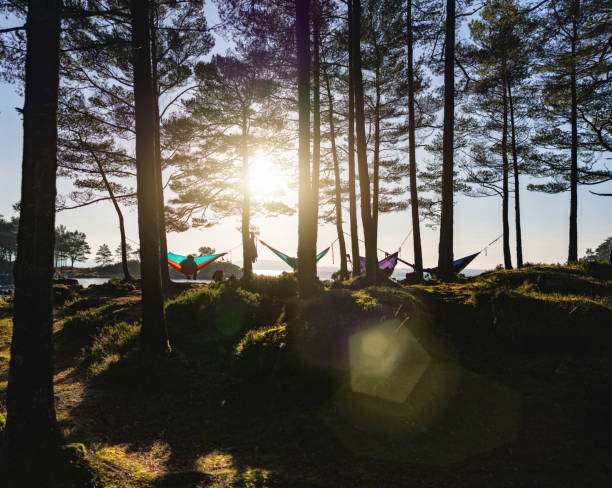
The most revolutionary advantage of hammock camping is that it completely abolishes the primary task of “finding level ground.” Whether on rugged hillsides, forests full of roots, damp riverbanks, or rocky seashores, finding a spot large, flat, and dry enough is usually the first challenge for traditional campers.
In contrast, an outdoor hammock only requires a proper distance between two sturdy trees (or posts). Instantly, you have a flat, suspended bed, far from crawling insects and ground moisture. This freedom allows you to choose your campsite based on the best scenery rather than the flattest ground.
A Sleep Quality Revolution: Cool, Contoured, and Zero Pressure Points
Many people who spend their first night in a hammock are surprised by the experience: “I actually slept through the night without back pain?”
There is science behind this. First, air circulation. Being surrounded by air on all sides solves the problem of stuffiness and moisture buildup inside a tent, making it especially refreshing in summer.
Second, ergonomic suspension. When you lie diagonally in a sufficiently wide hammock, your body naturally assumes a nearly flat position with a slight supportive curve for the back. This even support eliminates discomfort at pressure points (like hips and shoulders) caused by sleeping on hard ground. For many with mild back pain, this is actually a friendlier choice.
Discover the ultimate comfort for your next trip: [Explore Our Professional Hammock Systems]
Lighter Luggage, Faster Setup

For backpackers, a high-quality hammock system can often be lighter and more compact than a comparable lightweight tent and sleeping pad combo. The setup process is typically more intuitive: hang the hammock, pull up the bug net (if needed), and pitch the rainfly—your “aerial bedroom” is complete. Takedown is equally swift, allowing you to hit the trail faster in the morning.
A True Story: From Tent “Defector” to Hammock Apostle
My friend Anna, a veteran hiker, used to be a staunch tent advocate. The shift happened during a solo hike on the Appalachian Trail. Continuous rain turned the ground into a quagmire; even with a footprint, the inside of her tent was damp, and her sleep quality was abysmal.
The next day, she met a long-distance hiker traveling light, leisurely reading a book in a hammock between two trees—dry underneath and refreshed. She tried his spare hammock. That night, despite the drizzle, she lay suspended under the rainfly, listening to the white noise of raindrops on the fabric, feeling dry and warm for the first time on a rainy camping night.
“It was a feeling of being embraced and safe, rather than being trapped in a cage.”
Upon her return, she immediately researched a hammock system. Now, she has become the “Hammock Ambassador” of our circle, tirelessly showing new friends the magic of suspended sleep on every trip.
What Kind of Hammock Do You Need for an “Overnight in the Air”?
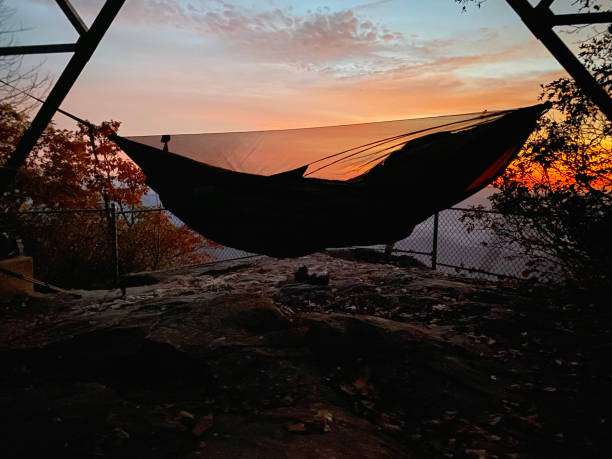
Not all outdoor hammocks are suitable for overnight stays. Casual daytime models might be too short, too narrow, or lack necessary accessories. A reliable hammock camping system needs to consider these core elements:
- Size is Key: Always choose a double-sized hammock, even if you sleep alone. The extra width is the physical foundation that allows you to lie diagonally for a flat sleeping area. A narrow hammock will make you curve like a banana, preventing sleep.
- Material and Weight Capacity: Overnight use means sustained weight and friction. Fabrics need to be durable; high-strength ripstop nylon is the mainstream choice. The weight capacity should have plenty of redundancy, such as a 300 kg rating, providing absolute safety for various sleeping positions.
- Integrated Convenience: For beginners, choosing a hammock designed for overnight use saves a lot of trouble. Some models use tent-like construction concepts, with built-in or easily attachable mosquito nets, giving you a complete, bug-proof sleeping space without extra hassle.
- Don’t Forget Accessories: The hammock itself is not waterproof. A lightweight rainfly is a necessity—it acts as your roof. In cooler seasons, a specialized hammock underquilt or pad (to prevent heat loss from the bottom) is also essential for warmth.
Frequently Asked Questions (FAQ)
|
Question |
Expert Answer |
|---|---|
|
Will I fall out of the hammock? |
As long as it is hung correctly (with a proper curve, not drum-tight), you are actually in the deepest part of the hammock. The risk of falling out is extremely low. |
|
Is it only for summer? |
No. By using “insulation layers” like underquilts or pads, you can prevent the wind-chill effect. It can be comfortable from spring through autumn. |
|
What if there are no trees? |
This is a limitation, but there are solutions like dedicated stands or using vehicle anchor points and trekking poles. |
Moving from a tent to a hammock is more than just a change of gear; it’s a change in how you interact with nature. It allows you to shift from “living on the ground” to “suspending within nature,” merging into the forest and the starry sky with a lighter, more open posture.
This isn’t to say you should abandon tents entirely. But for many outdoor enthusiasts pursuing lightweight travel, better sleep quality, or just a fresh experience, a reliable outdoor hammock undoubtedly opens a new door. It invites you to feel the wilderness night from a new perspective—a gentle, swaying, off-ground perspective. Perhaps your next adventure should start by leaving the ground. When you sway gently into sleep in the breeze, you’ll find that good dreams can indeed be suspended in the air.
Upgrade outdoor sleep comfort with a lightweight hammock camping system for backpacking, forest camps, and uneven terrain adventures.